
/
/
Whitepaper EMS and dynamic electricity tariff

Dynamic tariffs and intelligent charging: cost-efficient EV infrastructure through EMS

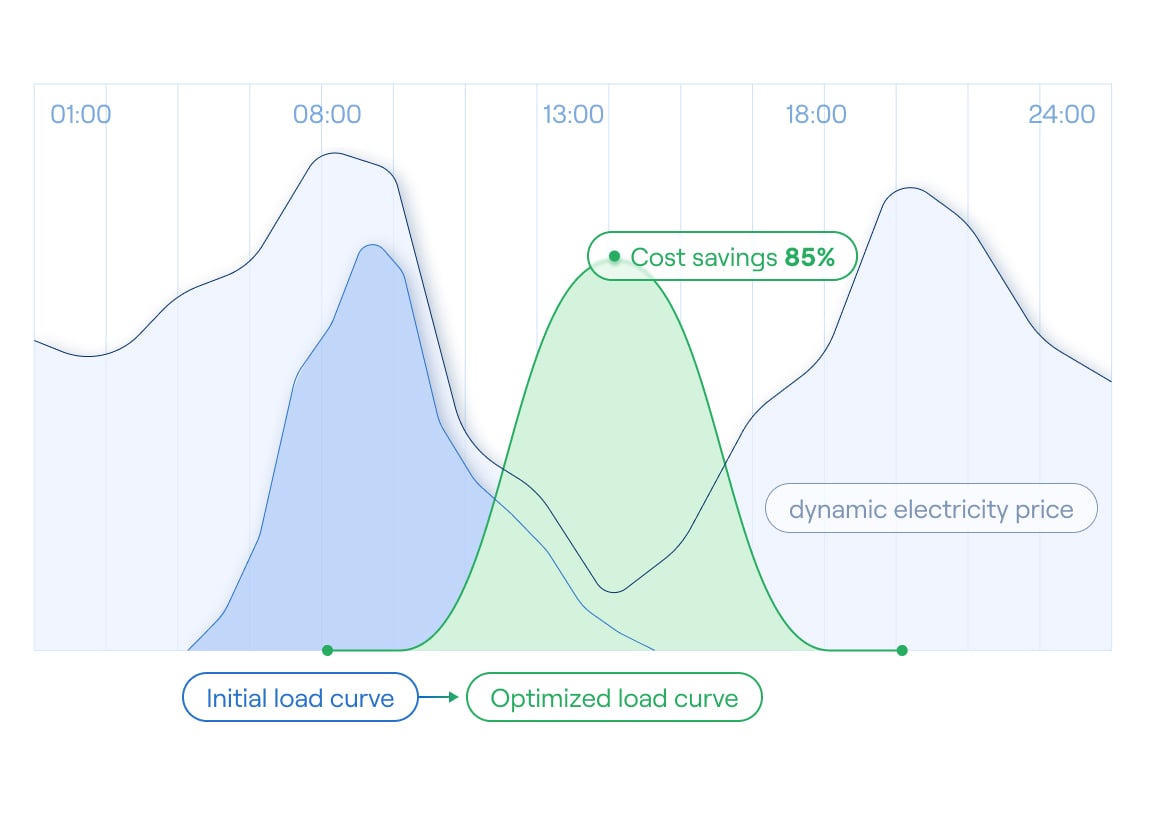
Dynamic electricity tariffs and intelligent energy management are changing how charging infrastructure is planned and operated. They make it possible to charge at the most favorable times, make optimal use of PV power and avoid peak loads in a targeted manner.

The result: noticeably lower energy costs, greater efficiency and more sustainable operation. Find out how this interaction works – and what potential it holds – in the following overview.

1. The shifting energy landscape

The electrification of mobility is accelerating across Europe. By 2030, an estimated 50 million EVs will be on European roads, demanding charging infrastructure that is both scalable and cost-efficient. At the same time, electricity markets are undergoing a structural shift:

Volatility of wholesale electricity prices is increasing due to renewable energy integration.
Dynamic tariffs (time-of-use, real-time, spot-market-based) are becoming more widespread, incentivizing consumption in periods of abundant and cheap renewable supply.
Grid operators are seeking flexibility from consumers to balance peaks and avoid expensive reinforcements.

This dynamic brings both opportunities and challenges for charging electric vehicles. Operators, fleet owners and companies must ensure cost savings and at the same time guarantee reliable availability of charging facilities.

2. Understanding dynamic tariffs

From static to dynamic

Unlike traditional tariffs, where a kilowatt hour always costs the same regardless of the time of day, dynamic tariffs reflect actual market conditions and can fluctuate hourly – or even every 15 minutes – based on real-time prices (RTP) determined on wholesale markets such as EPEX Spot .

Spotlight

In Germany (Q2 2025), the day-ahead wholesale electricity market showed prices between -25 cents/kWh (negative prices during PV peaks) and
60 cents/kWh during some evening hours with high demand. This range illustrates the savings potential of up to 85 % if consumption is shifted intelligently.

3. The relevance for the charging infrastructure

Cost savings potential

For commercial operators of charging infrastructure:

Fleet depots: By shifting the charging process to times when prices are low, operating costs can be significantly reduced.

Charging at the workplace: Adapting to the PV surplus at midday reduces both costs and the load on the grid.

Public charging centers: Even partial load shifting (e.g. by slowing down non-urgent charging processes) reduces energy costs.

Sample calculation

Fleet depot with 50 electric vehicles, each consuming 25 kWh/day = 1250 kWh/day
Static tariff: 35 cents/kWh → € 437.50/day
With dynamic tariff (25 cents/kWh) and optimization via reev: average tariff reduced to → 312.50 €/day
Annual savings: €45,625.

4. The role of energy management systems (EMS)

From monitoring to optimization

The main tasks of an EMS are to protect a building from overloading and to ensure efficient load distribution for optimizing grid charges and faster charging. In addition, the EMS is also the intelligent interface that converts tariff signals into feasible charging plans.

The role of the EMS as an intelligent control unit:

– Real-time tariff integration: Connection to spot markets for optimized electricity procurement
– Forecasts: Prediction of price curves and charging requirements for electric vehicles.
– Optimization algorithms: Scheduling charging at the most favorable times, taking mobility requirements into account.

Spotlight

The latest research results underline the considerable cost-saving potential of intelligent charging management.

According to Fraunhofer ISE (2023) , optimized and dynamic charging strategies can reduce overall charging costs by 30 to 60 % compared to uncontrolled charging. The study emphasizes that the level of savings depends on three main factors:

Tariff structure: The greater the spread between high and low electricity prices (as with dynamic or real-time pricing models), the greater the savings potential.
– Flexibility in charging times: Fleet and workplace scenarios with predictable parking times can realize the greatest savings.
– Integration of renewable energy generation: In combination with PV systems and self-consumption management, cost savings can exceed 60% as the EMS adapts charging to both low market prices and solar peaks .

Additional analyses by the International Energy Agency (IEA, 2024) confirm that smart load management not only lowers costs, but also reduces electricity-related CO₂ emissions by up to 25 %, as charging is shifted to periods with a higher proportion of renewable electricity.

Together, these findings underline that data-driven energy management – as implemented in integrated platforms such as reev – transforms electric vehicle charging into an active lever for economical and sustainable operation.

5. Integration of photovoltaics (PV)

The PV-EMS symbiosis

As businesses and depots increasingly install PV systems, the use of an EMS becomes essential to maximize self-consumption and reduce grid dependency.

The EMS optimizes consumption based on the following factors:

PV generation forecasts (weather, production profiles).
Dynamic tariffs (if PV generation is insufficient, market prices play a role).
Demand curves (charging windows and mobility requirements).

Example scenario

– Depot with 500 kWp PV system, production costs of 6 cents/kWh and average grid price of 25 cents/kWh (with reev electricity tariff)

– The EMS prioritizes the charging of electric vehicles during PV peak times at midday → average energy costs 6 cents/kWh instead of 25 cents/kWh

– PV generation decreases in the afternoon and is zero overnight. The EMS schedules the remaining required charging at times with low tariffs. Times with high tariffs are avoided, unless a vehicle has to leave the charging station promptly → The vehicles are always ready on time, but at the lowest possible cost

– The result: up to 80 % self-sufficiency and a 50 % reduction in total electricity costs.

6. Beyond the costs: additional benefits

Grid stability and flexibility

Dynamic tariffs in combination with an intelligent EMS adapt the charging behavior to the requirements of the power grid. The EMS automatically shifts charging to times with low prices and low utilization and reduces demand at peak times. This turns the EV infrastructure into a valuable flexibility resource, helping to absorb excess renewable energy when it is available and relieve the grid when it is heavily used at other times. The result is improved grid stability, reduced investment needs for grid operators and a more responsive and resilient energy system overall.

Durability

Charging during peak times of renewable energy generation not only lowers costs, but also significantly reduces the CO₂ impact of charging electric vehicles. By coordinating the charging process with times of high PV or wind availability, operators increase the proportion of green energy used and reduce dependence on fossil fuels in the electricity mix.

Scalability

As charging networks grow, the intelligent EMS ensures that operators can manage large fleets, multi-site hubs or expanding infrastructures without increasing complexity. Automated load management ensures limits are maintained during operation and avoids costly increases in grid connection power – all without affecting average charging speeds. By centrally coordinating tariffs, PV forecasts and vehicle demand, the overall system can be scaled from a few chargers to hundreds, with stable performance and minimal manual effort – enabling reliable, future-proof operation.

7. Challenges and trailblazers

– Availability of tariffs:
The market penetration of dynamic tariffs varies by country (e.g. well advanced in the Netherlands, still limited in Germany).

– Regulatory framework:
Incentives for flexibility vary by market.
Interface capability:
The EMS must be integrated into charging management systems (CPMS) and be able to receive grid signals.
– User acceptance:
Schedules must take mobility needs into account – drivers expect full batteries when needed.

reev: the all-in-one solution for energy and charging

While dynamic tariffs and intelligent EMS are often discussed as separate parts, in practice, integration is the key to simplicity and scalability. This is where reev offers a unique advantage.

The reev Platform not only provides its own integrated dynamic electricity tariff that feeds live price signals natively into the platform. The integrated EMS and charging management software also work together to convert these prices into actionable charging plans without the need for additional tools.

Advantages:

Seamless EMS integration
reev combines charging management and energy management in a single platform , eliminating the need for complex juggling with multiple systems.
– Integrated dynamic tariff
The integrated reev electricity tariff is fully interlinked with EMS and charging management, automatically accesses dynamic tariff data and plans charging processes so that they take place at the most cost-effective times – while fully ensuring vehicle availability.
– PV integration
Through intelligent forecasts, reev maximizes self-consumption of solar power and prioritizes green and cheap electricity when additional grid consumption is required.
– Scalability for operators
Whether fleet depot, charging station at the workplace or semi-public charging stations – reev’s modular solution can be adapted to local requirements.
– All-in-one platform
Operators benefit from centralized controlTariffs, EMS, charging management, reporting and user administration are coordinated, which massively reduces operating costs.

reev USP: By bundling charging management, energy management and dynamic tariffs in one platform, reev enables operators to save costs, act more sustainably and make operations more efficient – without additional complexity.

8. Conclusion

Dynamic tariffs are an important lever for the cost efficiency and sustainability of charging infrastructure for electric vehicles. However, their full potential cannot be exploited without intelligent coordination. Operators face the challenge of combining price signals, PV production, mobility requirements and grid signals into a coherent strategy.

This is precisely where the added value of reev lies. With its all-in-one platform and integrated dynamic electricity tariff , reev eliminates complexity by combining EMS, CPMS and tariff management. Charging schedules are automatically defined for the most cost-effective times, PV generation is prioritized and vehicles are reliably ready for use when needed.

By providing a seamless solution from tariffs to charging control , reev enables operators to reduce costs, improve sustainability and scale their infrastructure efficiently. Instead of piecing together multiple systems, operators get a single, transparent platform that ensures simple and future-proof operation.

In short, reev transforms dynamic tariffs into real, measurable savings and enables charging infrastructure operators to become relevant players in the energy transition – without compromising on service or performance.

You can reduce your costs too.

Here you will find all information about the reev energy and charging solutions

Wir unterstützen Sie gerne!

"*" indicates required fields

This field is for validation purposes and should be left unchanged.
Name*
Requested hardware *